


When Do Diverticulitis Symptoms Require Surgery?
Diverticulitis may require surgery when symptoms are severe, keep returning, or lead to complications such as significant inflammation, infection, abscesses, or other colon-related problems. Surgery may also be considered when conservative treatment does not provide lasting relief. Our team at Phoenix Unified Surgeons evaluates the frequency and severity of symptoms to determine whether colon surgery is an appropriate treatment option. For more information, contact us or request an appointment online. We are conveniently located at 20333 N 19th Avenue, Ste 230 Phoenix, AZ 85027.
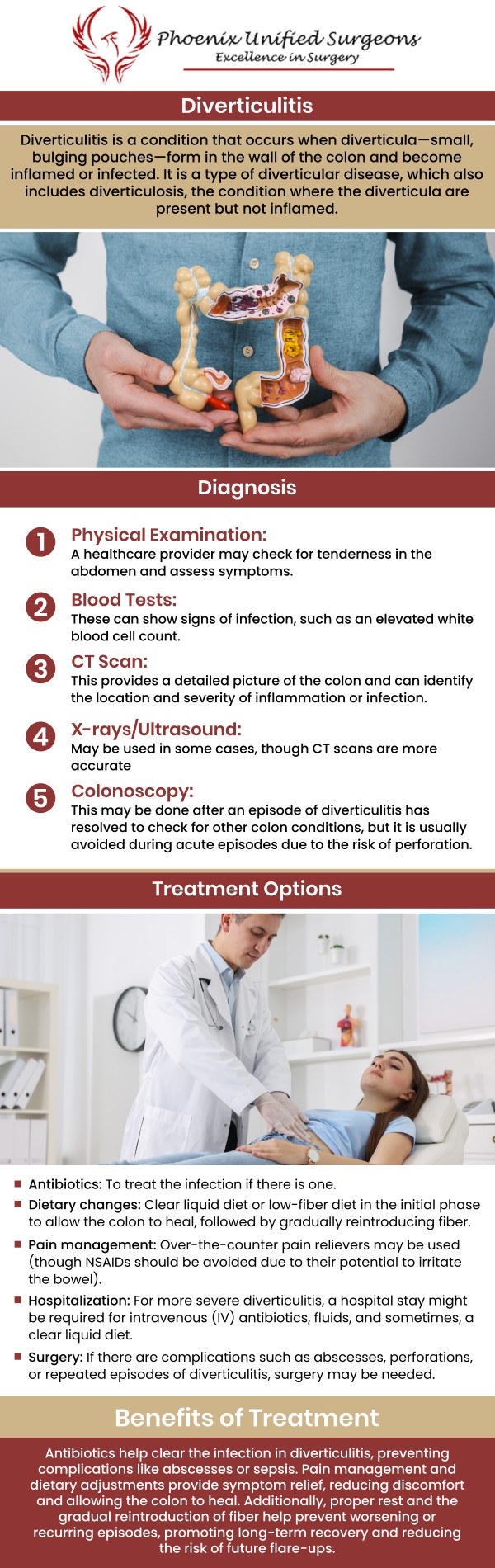
Table of Contents:
Does a diverticular abscess always require colon surgery?
Does a weakened immune system affect the decision to recommend diverticulitis surgery?
Can ongoing bowel changes after a diverticulitis flare-up require a surgical evaluation?
How do a patient’s overall health and symptom severity influence the timing of diverticulitis surgery?
What Factors Help a Board-Certified Surgeon Recommend Diverticulitis Surgery?
A diverticular abscess is a localized collection of pus that can develop as a complication of diverticulitis, when small pouches (diverticula) in the colon wall become infected or inflamed. At Phoenix Unified Surgeons, our experienced surgical team specializes in the evaluation and management of these complex conditions, providing each patient with an individualized treatment plan.
Not all diverticular abscesses require colon surgery. The approach our surgeons recommend depends on several factors, including the size of the abscess, severity of symptoms, and each patient’s overall health.
• Small Abscesses (<3 cm):
For smaller abscesses, intravenous antibiotics and close clinical monitoring are often effective. Our team provides hospital-based care to ensure the infection is controlled, monitoring for any changes that may require further intervention. In many cases, surgery can be avoided if the abscess responds well to medical therapy.
• Larger Abscesses (>3 cm):
When an abscess is larger, minimally invasive image-guided percutaneous drainage may be needed. We work closely with interventional radiologists to perform this procedure, combining drainage with antibiotics to resolve the infection. Many patients recover without the need for immediate colon surgery.
When Surgery Is Necessary
Surgical intervention may become necessary if an abscess does not respond to antibiotics and drainage, or if there are complications such as a perforated colon, widespread infection, or severe deterioration in the patient’s condition. In these situations, our board-certified surgeons at Phoenix Unified Surgeons are highly skilled in advanced colon surgery, including resection of the affected portion of the colon and, if needed, creation of a temporary colostomy.
Collaborative, Compassionate Care
At Phoenix Unified Surgeons, we believe in a multidisciplinary approach. We collaborate closely with gastroenterologists, interventional radiologists, and your primary care physician to determine the best treatment plan for each patient. Our goal is to ensure the safest and most effective care, tailored to your unique needs.
While some cases of diverticular abscess do require colon surgery, many can be managed successfully with antibiotics and, if necessary, percutaneous drainage. The decision for surgery is always individualized, based on the abscess size, your clinical response to treatment, and the presence of complications. If you have questions or need expert surgical care for diverticular disease, the team at Phoenix Unified Surgeons is here to support you every step of the way.
At Phoenix Unified Surgeons, your safety and optimal recovery are always our top priorities. When it comes to treating diverticulitis—especially in patients with a weakened immune system—our surgical team takes special care to tailor recommendations to your unique health needs.
The immune system is essential in fighting infection and supporting healing after surgery. If your immune system is compromised—due to conditions such as HIV/AIDS, the use of immunosuppressive medications (like steroids or drugs taken after organ transplantation), or chemotherapy—the risks associated with surgery can be significantly higher. These risks may include increased chances of postoperative infections, delayed wound healing, and other complications such as sepsis or slow recovery.
Because of these elevated risks, the surgeons at Phoenix Unified Surgeons approach surgical decisions for diverticulitis with added caution in immunocompromised patients. Whenever possible, we may recommend non-surgical management first. This could include antibiotics, dietary changes, and careful monitoring, especially if your episode of diverticulitis is uncomplicated.
Surgery is usually reserved for more severe situations—such as when there is a perforation, abscess, fistula, or repeated episodes that do not respond to conservative treatment. Before recommending surgery, our physicians will thoroughly assess your overall health, the severity of your diverticulitis, and the extent of your immune system suppression. We also work closely with specialists in infectious diseases and immunology to create the safest, most effective treatment plan.
In summary, at Phoenix Unified Surgeons, we recognize that a weakened immune system plays a significant role in the decision-making process for diverticulitis surgery. Our goal is to provide the highest level of care, favoring conservative treatment when appropriate, and ensuring that any surgical intervention is truly necessary and as safe as possible for your individual situation.
At Phoenix Unified Surgeons, we understand that experiencing changes in bowel habits after a diverticulitis flare-up can be concerning. While it is normal to notice some temporary changes in bowel patterns following an episode of diverticulitis, persistent symptoms such as constipation, diarrhea, abdominal pain, or rectal bleeding may signal a more serious underlying issue that deserves prompt attention from a surgical specialist.
If you are experiencing ongoing symptoms after diverticulitis, these could be due to complications like strictures (narrowing of the colon), abscesses, fistulas, or chronic inflammation. Our board-certified surgeons at Phoenix Unified Surgeons are highly experienced in evaluating and managing these complex conditions.
A surgical evaluation at our practice is especially important if:
• Symptoms do not improve with standard medical treatments
• There are signs of bowel obstruction
• Imaging studies reveal complications
• There’s any concern for underlying malignancy (particularly in patients over 50 or with a family history of colorectal cancer)
Our team will work closely with you to assess your individual situation using the latest diagnostic tools, including colonoscopy if needed, and will discuss all potential treatment options. The decision for any surgical intervention is personalized, taking into account the severity of your symptoms, the presence of complications, and your overall health.
At Phoenix Unified Surgeons, the decision to proceed with surgery for diverticulitis is always personalized to meet each patient’s unique needs and medical circumstances. Our experienced team understands that the timing of surgical intervention depends on a careful assessment of your overall health and the severity of your symptoms.
For many patients who are otherwise healthy and experiencing mild, well-controlled symptoms, our surgeons may recommend a non-surgical approach. This can include medical therapies such as antibiotics, dietary modifications, and attentive monitoring in our care. In such cases, surgery may be safely delayed—or even avoided—unless recurrent episodes or complications arise.
However, when symptoms are more severe—such as persistent abdominal pain, fever, inability to tolerate food or liquids, or evidence of complications like abscesses, perforation, fistula, or bowel obstruction—our Phoenix Unified Surgeons team may advise surgical intervention sooner. If life-threatening conditions such as generalized peritonitis or sepsis are present, emergency surgery may become necessary to protect your health and safety.
We also recognize that underlying medical conditions play a crucial role in surgical planning. Patients with weakened immune systems, multiple chronic illnesses, or advanced age may require earlier surgical management to prevent serious complications. Conversely, if a patient’s overall health increases the risk of surgery—such as those with significant heart or lung disease—our surgeons at Phoenix Unified Surgeons will thoroughly weigh the risks and benefits before making any recommendations.
Ultimately, our priority is to provide a tailored, evidence-based approach for every individual. At Phoenix Unified Surgeons, we carefully balance the potential risks of surgery against the dangers of recurrent or complicated diverticulitis, ensuring you receive the most appropriate and compassionate care every step of the way.
At Phoenix Unified Surgeons, every patient with diverticulitis receives a comprehensive, individualized evaluation by Dr. Debora J. Fox, MD, MBA, FACS, FASCRS and our experienced surgical team. Our approach to recommending surgery is based on a careful assessment of several critical factors to ensure the best outcomes for our patients.
We closely monitor the severity and frequency of diverticulitis attacks. If you have experienced multiple episodes, especially if they are severe or do not improve with antibiotics and dietary adjustments, our surgeons will discuss whether surgery might provide you with lasting relief and prevent further complications.
We understand how ongoing symptoms can disrupt your daily life. Our surgeons prioritize your quality of life and will discuss elective surgery as an option if persistent symptoms are affecting your well-being, even in the absence of acute complications. We believe in transparent, shared decision-making, ensuring you are fully informed about all your options.
At Phoenix Unified Surgeons, every decision regarding diverticulitis surgery is made collaboratively between you and your surgical team. We are dedicated to providing compassionate, evidence-based care and guiding you through every step, from diagnosis to treatment and recovery. For more information, contact us or request an appointment online. We are conveniently located at 20333 N 19th Avenue, Ste 230 Phoenix, AZ 85027. We serve patients from Phoenix AZ, Sun City AZ, Peoria AZ, Surprise AZ, Glendale AZ, Scottsdale AZ, and surrounding areas.
Check Out Our 5 Star Reviews



Additional Services You May Need
▸ Colon & Rectal Surgery
▸ Gallbladder Surgery
▸ Colonoscopy
▸ Wound Care
▸ Hernia Repair
▸ General Surgery
▸ Robotic and Minimally Invasive Surgery
▸ Appendectomy
▸ Colon Repair/Resection
▸ Lipoma & Cyst Removal
▸ Endoscopy and Colonoscopy
▸ Abdominal Pain
▸ Colon surgery for Diverticulitis
▸ Colon surgery for Colon Cancer
▸ Hemorrhoids
▸ Anal Fistulas
▸ Anal Pain Surgeries
▸ Colostomy Avoidance Surgery
▸ Fecal Incontinence Surgery
▸ Crohn’s Surgery
▸ Ulcerative Colitis Surgery
▸ TIF Procedure
▸ Colon Fistulas
▸ Groin Hernia
▸ Inguinal Hernias
▸ Hiatal Hernia
▸ Colon-Bladder Fistulas
▸ Colon Diverticulitis
▸ Hiatal Hernia Surgeon
▸ Gastroesophageal Reflux Disease
▸ Colon and Rectal Cancer Surgical Management
▸ Incisional Hernia
▸ Giant Hernias
▸ Skin Cancer
▸ Breast Cancer Screening
▸ Open and Nonhealing Wounds
▸ Incisionless Hiatal Hernia Repair
▸ Lipomas and Common Skin Growths
▸ Surgical Second Opinions
▸ Feeding Tube Access Including PEGs and G Tubes
▸ Upper GI Endoscopy Care
▸ Board-Certified General Surgeons, Colon and Rectal Surgeons
▸ Colon and Rectal Surgeon vs. Gastroenterologist
▸ Colon-Vaginal Fistulas
▸ Port Placements for IV Access
▸ Colostomy Reversal
▸ Abdominal Wall Hernia


 Send Text
 How May I Help You?